
Synopsis
Escalating tensions involving the U.S., Iran, and Israel have triggered one of the largest oil supply shocks in decades, pushing Brent crude sharply higher as markets price disruptions in the Strait of Hormuz. With nearly 20% of global oil flows at risk, energy markets, currencies, and equities are rapidly repricing geopolitical risk.
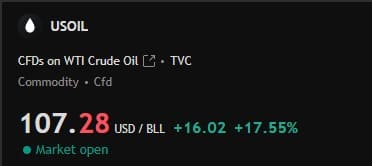
The global energy market is witnessing one of the most dramatic supply shocks in modern history. Oil prices surged nearly 20–25% in a single session, pushing Brent crude above $110–$119 per barrel, the sharpest spike since the 2022 energy crisis. The surge has been triggered by escalating conflict involving the U.S., Israel, and Iran, which has disrupted production and shipping across the Middle East. The biggest concern is the Strait of Hormuz, a narrow maritime chokepoint through which roughly 20 million barrels of oil per day—around 20% of global supply—normally flows. With tankers avoiding the route and infrastructure under attack, the world is suddenly facing a massive short-term supply disruption. Markets are responding violently: equities are falling, the U.S. dollar is strengthening as investors seek safety, and commodities tied to energy and inflation are surging.
What makes this moment historically significant is the scale of the disruption. Past supply shocks—from the 1973 Yom Kippur War to the 1979 Iranian Revolution—removed between 4 and 5 million barrels per day from the market. Today’s disruption risks impacting up to 20 million barrels per day, potentially exceeding several historical shocks combined. At the same time, alternative pipelines and bypass routes can handle only a fraction of the normal Hormuz traffic, leaving global markets extremely vulnerable. If the disruption persists, oil prices could climb further toward $120–$150, reigniting global inflation and tightening financial conditions. The world is currently in stage one of an energy shock. Whether it evolves into a broader financial crisis will depend on how long supply disruptions last and how quickly energy flows through the Gulf can be restored.
The Day Oil Shocked the World
How a Middle East Conflict Triggered One of the Largest Energy Supply Disruptions in History
Global financial markets occasionally experience moments that redefine the economic landscape. March 2026 may become one of those moments. In a matter of hours, crude oil surged nearly 20% in overnight trading, one of the largest single-session moves seen in modern energy markets. Such moves are not ordinary volatility; they represent a fundamental repricing of risk across the entire global economy.
The catalyst was the rapid escalation of tensions involving the United States, Iran, and Israel, which has sent shockwaves through the world’s most critical energy corridor — the Strait of Hormuz. This narrow passage between Iran and Oman serves as the gateway for a massive share of global oil and gas flows. When instability threatens this corridor, markets react immediately.
What we are witnessing right now is not just a price spike. It is the early phase of a global energy supply shock.
Why the Strait of Hormuz Matters
The Strait of Hormuz is arguably the most strategically important oil chokepoint on the planet. Every day, millions of barrels of crude oil and refined products pass through this narrow shipping lane, supplying the world’s largest economies.
Key facts about the region:
- Nearly 20 million barrels of oil per day typically pass through the Strait of Hormuz.
- This represents around 20% of global oil consumption.
- The route supplies energy to major importing economies including China, India, Japan, and South Korea.
- Several of the world’s largest oil producers rely heavily on this corridor to ship crude to international markets.
When geopolitical tensions threaten this route, even the possibility of disruption can cause a violent reaction in oil prices. This week, those fears have moved from theoretical to real.
The Largest Oil Supply Shock in Decades
The current crisis has created what may become the largest oil supply disruption in modern history.
In just over a week, markets are estimating that close to 20 million barrels per day of supply could be impacted, either due to shipping disruptions, production shutdowns, or export interruptions across the Gulf region.
To understand the scale, it helps to compare it with past historical oil shocks.
Historical Oil Supply Disruptions
- Hormuz Closure Risk (2026): ~20 million barrels/day potentially disrupted
- Iranian Revolution (1978–79): ~5.5 million barrels/day
- Yom Kippur War Oil Embargo (1973): ~4.5 million barrels/day
- Iraq-Kuwait War (1990): ~4.3 million barrels/day
- Iran-Iraq War (1980): ~4.0 million barrels/day
- Russia–Ukraine War Energy Shock (2022): ~2.0 million barrels/day
The current disruption risk is roughly equivalent to several historic shocks combined, which explains why markets are reacting so aggressively.
Production and Infrastructure Disruptions
The crisis is not limited to shipping routes alone. Production and refining infrastructure across the region are also being impacted.
Several developments are contributing to tightening supply conditions:
- Iraqi production disruptions: Approximately 2.3 million barrels per day of supply is affected due to security concerns and export bottlenecks.
- Iranian exports halted: Around 1.4 million barrels per day of Iranian exports have stopped reaching global markets.
- Kuwait production cuts: Output reductions of roughly 300,000 barrels per day have been reported.
- Refinery outages: Saudi Arabia’s Ras Tanura refinery, one of the largest facilities in the world with a capacity of around 550,000 barrels per day, has faced operational disruptions.
- Global LNG risk: Qatar, which supplies roughly 20% of global LNG, has also slowed shipments amid regional instability.
The result is a cascading effect across the global energy system. Oil production, refining capacity, and transportation infrastructure are simultaneously facing stress.
How Global Markets Are Reacting
When energy markets experience a shock of this magnitude, every major asset class begins to react.
The cross-asset signals currently tell a clear story.
Oil Markets
Crude oil prices surged nearly 20% overnight, as traders aggressively priced in the risk of supply shortages and shipping disruptions.
Equity Markets
Global equity futures have weakened as investors worry that higher energy prices will raise inflation and reduce economic growth.
Energy shocks historically act as a tax on global consumption. When oil becomes expensive, everything from transportation to manufacturing becomes more costly.
The U.S. Dollar
The U.S. dollar has strengthened, as global capital seeks safety in the world’s reserve currency during periods of geopolitical stress.
Precious Metals
Precious metals are showing mixed behavior:
- Gold has remained relatively stable, reflecting its traditional role as a safe-haven asset.
- Silver has fallen more sharply, which is often a sign of deleveraging rather than collapsing demand.
Silver tends to behave partly like an industrial metal, so during risk-off environments it often underperforms gold.
Bond Markets
Bond yields are moving in both directions, highlighting a difficult dilemma for investors.
Markets are trying to price two opposing forces simultaneously:
- Higher inflation due to energy prices
- Potential economic slowdown caused by the shock
This tug-of-war between inflation and recession risk is creating volatility across global fixed income markets.
Stage One: The Energy Shock
At the moment, the global financial system appears to be in stage one of the crisis — an energy supply shock.
Energy shocks are powerful because they affect nearly every sector of the global economy:
- Transportation costs increase
- Manufacturing input prices rise
- Inflation expectations climb
- Central banks face policy dilemmas
- Consumer spending slows
However, not every energy shock turns into a full financial crisis. Much depends on how long the disruption lasts.
When Could It Become a Systemic Crisis?
For the current situation to evolve into a full-scale global deleveraging event, several developments would likely need to occur.
1. Oil Prices Continue to Surge
If crude oil moves above $115–$120 per barrel and sustains those levels, global inflation expectations could rise sharply.
2. Equity Markets Accelerate Lower
Persistent energy inflation could tighten financial conditions and push equity markets into deeper corrections.
3. Credit Markets Show Stress
A widening of corporate credit spreads would indicate growing stress in the financial system.
4. Bond Market Volatility Surges
If bond markets struggle to price the balance between inflation and recession, volatility could spike sharply.
5. Gold Significantly Outperforms Silver
A decisive move where gold strongly outperforms silver often signals that investors are shifting into full defensive mode.
This is the stage where forced liquidation and deleveraging events typically begin.
Why Energy Shocks Matter So Much
Energy is the foundation of the global economy. Oil powers transportation, industry, agriculture, and global supply chains. When oil prices spike suddenly, the effects ripple across every major sector.
History has shown that major oil shocks often coincide with economic slowdowns.
Examples include:
- The 1973 oil embargo, which contributed to global stagflation
- The 1979 Iranian Revolution, which triggered a severe energy crisis
- The 2008 oil spike, which preceded the global financial crisis
While the causes differ, the mechanism is similar: energy price shocks tighten economic conditions quickly.
The Road Ahead
Right now, markets are still trying to determine whether this event will remain a short-term geopolitical shock or evolve into something far more serious.
Several factors will determine the trajectory:
- Whether shipping through the Strait of Hormuz resumes normally
- Whether regional production stabilizes
- Whether major oil producers increase supply to offset losses
- How long the geopolitical conflict continues
If energy flows are restored quickly, oil prices may stabilize and financial markets could recover.
But if disruptions persist, the global economy may enter a new phase of higher inflation, tighter liquidity, and slower growth.
One Thing Is Certain
A 20% overnight move in crude oil is not normal market noise.
It is the type of move that forces investors, governments, and central banks across the world to reassess risk immediately.
Energy shocks of this magnitude rarely remain isolated events. They ripple across currencies, equities, commodities, and bond markets simultaneously.
Whether this becomes a short-lived spike or the beginning of a larger financial adjustment will become clearer in the coming weeks.
But for now, the message from markets is unmistakable.
The world has entered a period of energy uncertainty — and every asset class is beginning to reprice that reality.
Disclaimer:
This blog is for informational and educational purposes only and does not constitute investment advice, a recommendation, or an offer to buy or sell any financial instrument. Views expressed are based on publicly available information and market understanding at the time of writing and are subject to change. Readers should consult their financial advisor before making any investment decisions. Investments in markets are subject to risk.